
Locating Linguistic Origins
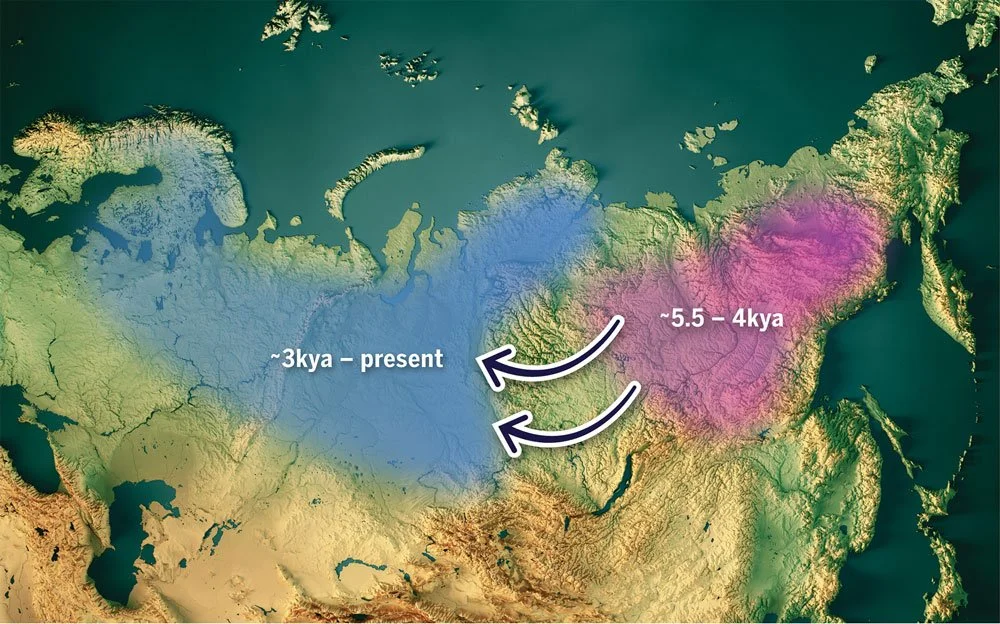
Uralic languages like Finnish and Hungarian are distinctly different from Indo-European languages that dominate much of Europe. So where in the world did this family of languages, spoken by about 25 million people, come from?
A team of researchers, including Vagheesh Narasimhan, a UT assistant professor of integrative biology and of statistics and data sciences, used ancient DNA to reconstruct the prehistoric origins of two major Eurasian language families: Uralic and Yeniseian (now spoken only by the Ket people in Siberia). Linguists have long believed that Uralic languages originated in the Ural Mountains of western Russia, but the researchers discovered that they probably began thousands of kilometers further east, in central Siberia.
Ancient DNA helped reconstruct the prehistoric origins of two major Eurasian language families.
The team conducted genome analysis of 180 individuals from northern Eurasia, dated between 17,000 and 3,000 years ago. From there, the researchers identified two ancestral populations that gave rise to the two language families: one from the Lena River Basin in eastern Siberia, which contributed to nearly all modern Uralic-speaking populations, and another from the Baikal region in southern Siberia, associated with the Ket people.
A belt of genetically related hunter-gatherers from the Late Stone Age, spanning from modern-day western Russia to eastern Siberia, was disrupted around 4,200 years ago. As other groups moved in and mixed with them, the resulting new groups had certain lasting demographic and linguistic features. Some of these proto-Uralic people migrated westward as far as the Baltic Sea, possibly driven by a trading network for bronze tools and weapons.
“A language cannot be read directly from genomes, but when genetic ancestry, archaeological context and linguistic geography converge, robust inferences become possible,” the research team wrote in the journal Nature.